
History of the Bengal Handloom
- divyansuagarwal1
- Feb 26, 2023
- 4 min read
Updated: Feb 28, 2023

West Bengal has a rich tradition of Handloom Weaving. It occupies a big part of its cultural heritage. The textile products of Bengal have attracted not only national but also worldwide attention and bears the timeless legacy of our cultural heritage. ‘Jamdani’ and ‘Tangail’ are two pioneer sarees in the field of heritage handloom products of Bengal handloom. 'Jamdani' - the great characteristic of fine art in hand weaving derived from a Persian word 'Jam' meaning a 'cup' and 'dani' denotes the 'container'. Jamdani style of weaving flourished under the benign, rich and enlightened patronage of kings and emperors. It may be considered as a textile of excellence for its super fine qualities in the fifteenth & sixteenth centuries.
Excellence in weaving lies in the virtuosity of forms drawn from the social, religious and natural environment and translated through a particular technique and the weaver's sensitivity to create a new art form. 'Tangail' was originated from Tangail, a district of present day Bangladesh. Previously it was named as 'Begum Bahar' where silk warp and cotton weft were used. Later on, both cotton warp and weft were in vogue. The weavers consisted mainly of 'Basak' community who migrated from Tangail district before partition of our country & settled in Katwa, Dhatrigram, Tamaghata, Samudragarh area in Burdwan district. At present, silk Tangail sarees have been revived. The technique of drawing and weaving of extra weft for figured Tangail sarees is more or less identical to Jamdani sarees. Unlike Jamdani, two plain picks instead of a single pick are inserted after each extra weft meant for figured design.
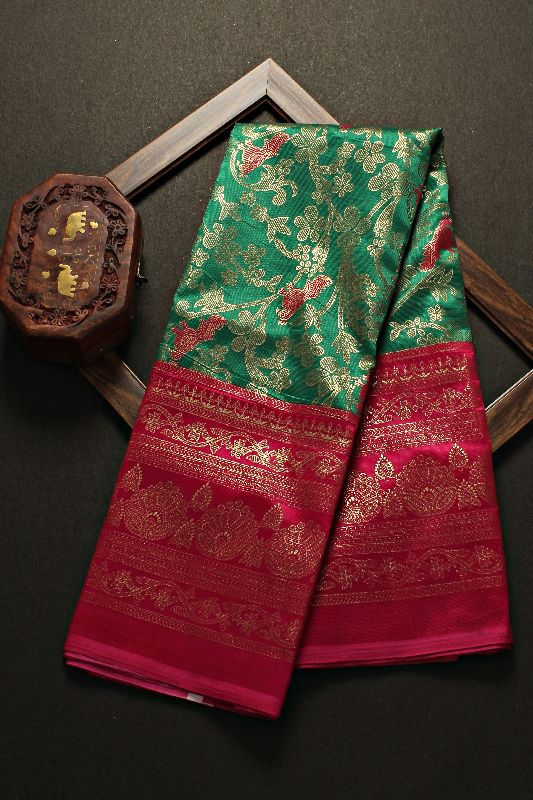
Silks of Bengal were much acclaimed the world over since ancient times. The most well known Bengal silk saree which carry its popular name is Baluchari saree - a production of exclusive design and fabulous weaving technique. A revival in recent time of both the Baluchari and another out standing traditional Bengal saree - 'Daccai' has lead to nation wide and world wide popularity and interest in Bengal silks. Like silks cotton sarees are also woven in a fascinating and exquisite range. The Daccai Jamdani is a fabric on which designs are raised in inimitable style. Handloom still remains the great employer of rural sector in Bengal. 3.5 lakhs handlooms exists in West Bengal till date. Santipur, Fulia in Nadia district, Dhaniakhali, Begampur in Hooghly district, Samudragarh, Dhatrigram, Katwa, Ketugram in Burdwan district, Bishnupur in Bankura district are the mainly handloom concentrated areas in the state of West Bengal.

Every tant sari has a story to tell—it is representative of the finest and most ancient weaving technique that originated in Bengal in the 15th century. Its unique identity is the result of Mughal patronage, ancient Hindu influences and a Bengali flair for design.
Tant refers to the handlooms in West Bengal which are used to weave saris and textiles. The earliest record of sari weaving in Bengal can be traced back to the 15th century in the Shantipur district. The art continued to flourish during the Mughal rule, from the 16th to the 18th centuries, when it received extensive royal patronage alongside muslin and jamdani. After the partition of Bengal in 1947, several weavers from Bangladesh migrated to India and were rehabilitated in West Bengal. Phulia, close to Shantipur, became a new home for these weavers from Tangail (in Bangladesh), who also brought their ancestral weaving traditions with them. Other weaver communities were settled in the Hooghly and Bardhaman districts of West Bengal. Over the years, each region has developed its signature style and are most well-known for their varieties of tant saris. They are woven with locally procured Bengal cotton. This fine handspun yarn results in soft, feather-light muslin and mulmul textiles that have been globally traded for ages now. Depending on the yarn quality, the sari is fine (combed cotton) or coarser (regular cotton). Textile innovations pave the way for new weaves and finishes.

As an economic trade and industrial activity, the ‘tantshilpa’ (art of weaving handloom saris) is second only to agriculture in providing a livelihood to the people of these communities. Typically, March and April are the busiest months, especially leading to up to Bengali New Year on April 14. But the ongoing pandemic and ensuing lockdown have led to insurmountable losses. The need of the hour is to mobilise retail for existing stock while also using e-commerce to boost business and revive endangered weaves and communities.

As a nation, we are obsessed with high-shine clothing, which explains our love for heavy silks and zari. Tant cotton, in comparison, is a modest choice. But that is also its true prowess. In fact, late former prime minister Indira Gandhi often wore a tant saris with minimal jewellery and her signature jacket or sweater blouses. After we overcome this period of global crisis, I strongly believe we will be increasingly drawn to indigenous authenticity with a focus on handmade, handloom, and traditional. 'Make in India' and 'buy local' is more relevant now than ever before, as each locally-made purchase directly supports homegrown fashion labels, regional weaves and in turn, funds its makers, that is, the weavers, tailors, embroiderers and craftsmen.
Comments